GHRP-2 (pralmorelin) is a synthetic peptide that tells your pituitary to release a pulse of growth hormone. It was the first growth hormone secretagogue used clinically and is still approved in Japan as a diagnostic agent to test pituitary function. In the peptide community it's used the same way Ipamorelin is, to push GH and IGF-1 higher with the goal of deeper sleep, faster recovery, gradual body composition changes, and better skin and connective tissue.
It's stronger than ipamorelin on raw GH output but less clean. GHRP-2 raises cortisol, prolactin, and appetite alongside the GH pulse, which is why most modern protocols moved to ipamorelin once it became available. If you're hearing about it today, it's usually because someone is running it for the stronger GH pulse or the appetite-stimulating effect (bulking, recovery from illness, building back muscle in older adults). Almost always stacked with a GHRH analogue like CJC-1295 no-DAC for the synergy.
Deep-dive
GH is released in pulses from the anterior pituitary under two opposing controls, GHRH (the gas pedal) and somatostatin (the brake), with ghrelin acting as a third input that amplifies the GHRH signal. GHRP-2 is a synthetic hexapeptide (D-Ala-D-2-Nal-Ala-Trp-D-Phe-Lys-NH2) that binds the ghrelin receptor (GHSR-1a) on pituitary somatotrophs and triggers a GH pulse the same way endogenous ghrelin does. GH then drives IGF-1 production in the liver and peripheral tissues, and IGF-1 mediates most of the anabolic, lipolytic, and tissue-repair effects people actually feel.
Pharmacokinetics. GHRP-2 has a plasma half-life of about 1 hour and produces a GH pulse that peaks around 15-30 minutes after subcutaneous or intravenous administration and returns to baseline by 2-3 hours. Pihoker's 1998 Phase 1 in children established the basic pharmacokinetic profile and showed that intranasal absorption is roughly 0.3-1% of the subcutaneous dose, which is why subcutaneous remains the practical route. One injection produces one clean pulse and clears. Dosing 2-3 times daily recreates discrete pulses rather than maintaining background elevation.
Potency and selectivity. GHRP-2 is one of the most potent GHRPs by raw GH output. Raun's 1998 swine comparison tested it head-to-head against GHRP-6, ipamorelin, and GHRH, and found GHRP-2 released GH with similar potency to the other GHRPs but, unlike ipamorelin, it also elevated ACTH and cortisol at GH-releasing doses. This is the central trade-off. GHRP-2 hits the ghrelin receptor strongly and selectively for GH release at the pituitary, but the same receptor activation also drives appetite, modest cortisol elevation, and modest prolactin elevation. Ipamorelin was specifically engineered to keep the GH effect while losing those side activities. GHRP-2 keeps them.
Synergy with GHRH analogues. The GHRH receptor and the ghrelin receptor sit on the same pituitary cells but signal through different pathways (cAMP for GHRH, calcium and PKC for ghrelin). Bowers' work on this in older adults showed that combining GHRP-2 with GHRH produces a GH pulse much larger than the sum of the parts, and that continuous subcutaneous GHRP-2 infusion (1 mcg/kg/hour for 30 days) raised IGF-1 levels and maintained pulsatile GH secretion. The practical translation is that GHRP-2 + a GHRH analogue (CJC-1295 no-DAC, sermorelin) is the standard stack, same as for ipamorelin.
Appetite is a feature, not a side effect, depending on what you're after. GHRP-2 reliably stimulates hunger in humans. Laferrère's 2005 trial infused 7 lean healthy men with GHRP-2 for 270 minutes and found they ate 36% more at a buffet meal compared to saline, with every single subject increasing intake. A follow-up in lean and obese subjects replicated the effect dose-dependently, with food intake up 33.5% at the higher dose. This is the cleanest separator between GHRP-2 and ipamorelin in actual use. If you want to gain weight, recover from cachexia or illness, or build muscle through a hard bulking phase, the appetite effect is useful. If you're trying to lose fat, it works against you.
Tolerance develops fast. This is one of the less-discussed limitations. Rahim 1998 gave healthy young men daily subcutaneous GHRP-2 for 5 days and found that the peak GH response fell from 83 mcg/L on day 1 to 51 mcg/L by day 5, a 38% drop. Serum IGF-1 didn't rise meaningfully across the 5 days, although osteocalcin (a tissue marker of GH activity) did increase. The takeaway is that the pituitary response attenuates with sustained daily exposure, which is the mechanistic argument for cycling and for not over-dosing. Long-term studies in older adults (Bowers 2001) showed IGF-1 elevation that was maintained over 30 days, suggesting attenuation can be partially overcome with the right population and dose, but the principle of receptor desensitisation with continuous use applies here more than to ipamorelin.
Human clinical data is moderate but indirect. GHRP-2 has more human data than ipamorelin, mostly because it was developed earlier and reached the diagnostic market in Japan. The data covers pharmacokinetics, GH response in growth hormone-deficient children, response in older adults with age-related GH decline, and acute appetite effects. There are no long-term randomised trials measuring body composition, lean mass, fat mass, sleep architecture, or skin metrics as endpoints in healthy adults. As with ipamorelin and CJC-1295, the popularity of GHRP-2 in the peptide world is driven by extrapolation from GH/IGF-1 biology, animal data, and consistent user reports.
Anecdotal pattern. The most consistently reported effects, usually within the first 1-2 weeks, are noticeably increased hunger (often the first and most obvious change, unlike with ipamorelin), deeper sleep and vivid dreams, faster recovery from training, and a sense of mild euphoria or warmth shortly after injection. Over 1-3 months people report improved skin firmness and hydration, modest visceral fat changes (though the appetite effect can wash this out), faster healing of small injuries and nagging soft-tissue issues, and easier muscle gain if calories are pushed. Less consistent: fat loss without dietary control, large strength changes, libido changes. Common complaints: flushing or warmth in the face for 30-60 minutes after injection, mild water retention, tingling or numbness in hands at higher doses, and occasional headache or lethargy if dosed too aggressively. The hunger is universal enough that it can be used as a crude potency check, if you're not getting noticeably hungrier on 200-300 mcg, the product is likely under-dosed or degraded.
Women. GH and IGF-1 biology is broadly similar between sexes but women have higher baseline GH pulse amplitude and a more pronounced response to oestrogen, which upregulates GH secretion. Bowers 2001 enrolled both older men and women and showed comparable GH and IGF-1 responses to GHRP-2 in both sexes. Practically, women tend to use the same or slightly lower dose range as men and report similar effects on sleep, recovery, hunger, and skin. The appetite effect is reported as strongly in women, sometimes more so. Perimenopausal and postmenopausal women may notice more benefit because endogenous GH output declines alongside oestrogen, which leaves more room for an evoked pulse to register. Skip GHRP-2 in pregnancy and breastfeeding, the GH/IGF-1 axis is tightly regulated during these periods and there's no safety data.
Older adults. GH output declines roughly 14% per decade after age 30. GHRP-2 has more clinical data in older adults than most GHRPs because Bowers' work specifically targeted age-related GH decline. The Bowers 2001 study showed that continuous subcutaneous GHRP-2 in older men and women restored a more youthful GH pulse pattern and elevated IGF-1 sustainably over 30 days. Long-term safety in this group is the weakest part of the evidence base, see the risks section for IGF-1/cancer and glucose-handling considerations.
Limitations of the evidence. Solid pharmacokinetic data, solid acute pharmacodynamics, decent short-term clinical data in growth hormone-deficient children and older adults, no long-term randomised body composition trials in healthy adults. Tolerance develops with daily dosing in young healthy subjects. The compound is widely sold as a research chemical from grey-market suppliers, product purity and identity vary, and outside Japan (where it's approved as a diagnostic agent) it has no approved human therapeutic indication. The FDA placed GHRP-2 on the 503A Category 2 bulks list in 2023 alongside other GH-releasing peptides, citing immunogenicity and impurity concerns.
Dosage:
- Standalone GHRP-2: 100-300 mcg subcutaneous, 2-3x daily. Most common single dose is 200 mcg pre-bed. The pituitary saturates around 300 mcg per pulse, going higher doesn't produce more GH, just more side effects (water retention, tingling, lethargy, stronger hunger)
- CJC-1295 (no-DAC) + GHRP-2 stack: 100 mcg of each, taken together in the same syringe, 2-3x daily. Pre-bed is the priority dose, pre-workout is next, and a morning dose rounds out a full protocol. This stack is the standard if you're picking GHRP-2 over ipamorelin
- Timing: Inject on an empty stomach, 30-60 minutes before food. Elevated insulin and amino acids from a meal blunt the GH pulse via feedback at the pituitary. Pre-bed dosing aligns with the natural nighttime GH surge during deep sleep and is the most effective single dose
- Frequency over dose. GHRP-2 desensitises faster than ipamorelin with sustained daily use, see Rahim 1998. The lever is more frequent smaller pulses, not higher single doses. 3 daily injections at 100 mcg outperform one daily injection at 300 mcg for sustained effect
- Cycling: Most protocols run 8-12 weeks on, then 4-6 weeks off. The off period lets pituitary sensitivity reset and gives you a window to recheck IGF-1, fasting glucose, and HbA1c. The shorter cycles versus ipamorelin reflect the faster tolerance development
- Women: Same dose range as men, often starting at 100 mcg per injection and adjusting over 4-6 weeks. Perimenopausal and postmenopausal women may notice effects faster because endogenous GH baseline is lower. The appetite effect is reported equivalently or more strongly in women, factor this into the bulking/cutting decision
- Reconstitution: Comes as lyophilised powder, reconstitute with bacteriostatic water, store refrigerated, use within 30 days. Subcutaneous injection into abdominal fat or thigh with an insulin syringe. Rotate sites
- Stacks: The standard pairing is CJC-1295 no-DAC for the synergy. Some run alongside BPC-157 for tissue repair during injury cycles. Stacking with exogenous HGH is redundant and shuts down the natural pulse. Don't combine with ipamorelin, they target the same receptor and you just get more side effects without more GH
Here's what you can expect:
The first thing most people notice within the first few days is a sharp increase in appetite, often within an hour of the first injection. This is the most reliable early signal that the product is bioactive. Deeper sleep and more vivid dreams typically follow in the first 1-2 weeks. Faster recovery between training sessions tends to show up within the first month. Skin firmness and hydration improvements come gradually over 2-3 months, similar to 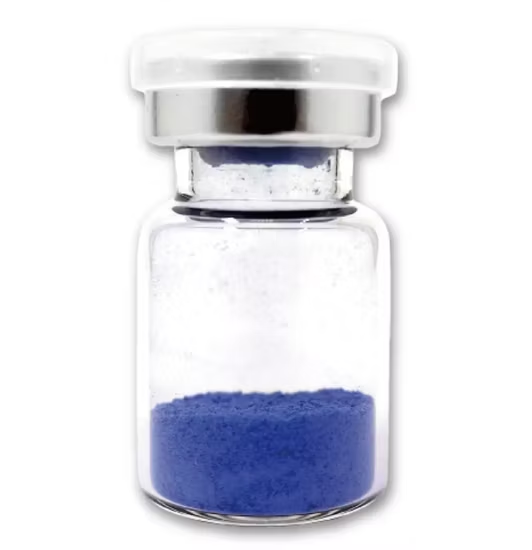 GHK-Cu but driven by IGF-1 rather than direct fibroblast signalling. Body composition changes (modest visceral fat reduction, lean mass gain) build over 3-6 months and require that you're also training and eating in line with your goal, the appetite effect makes this a tool that works with bulking and against cutting.
Mild facial flushing in the 30-60 minutes after injection is normal and usually fades after the first few doses. If you're not noticing increased hunger or anything else after a week at a standard dose, the product is likely under-dosed, degraded, or mislabelled. Grey-market sourcing variance is the most common reason people report nothing.
Side effects & risks:
- Strong appetite stimulation. Universal, dose-dependent, and the main reason GHRP-2 isn't the default GHRP anymore. Useful if you want it, a real problem if you don't
- Cortisol and prolactin elevation. Modest at standard doses, more pronounced at higher doses. Can manifest as anxiety, mild water retention, mood changes, and in rare cases gynecomastia symptoms at the upper end. The Raun comparison showed this is the main distinguishing feature versus ipamorelin
- Injection site reactions: mild redness, itching, occasional bruising. Rotate sites
- Facial flushing and warmth in the first 30-60 minutes after injection. Vasodilatory effect, harmless, usually fades after the first few doses
- Headache, lethargy, brain fog at higher doses or if dosed too late in the day. Pull the dose back
- Water retention and tingling (paraesthesia) in hands and feet at the upper end of the dose range. Early sign of carpal tunnel-type symptoms from elevated GH/IGF-1. Reversible. Reduce dose
- Insulin resistance and elevated fasting glucose. GH is counter-regulatory to insulin and sustained elevation pushes fasting glucose and HbA1c up. Most people see modest changes but meaningful if you already have prediabetes or metabolic syndrome. Recheck at 3 months
- Tolerance/tachyphylaxis. GHRP-2 desensitises faster than ipamorelin with sustained daily use, response attenuates within days at high doses in young healthy subjects. The mechanistic reason most protocols cycle on the shorter end (8-12 weeks)
- Active or recent cancer, avoid. IGF-1 is mitogenic and elevated IGF-1 is epidemiologically associated with increased risk of several cancers (colorectal, prostate, breast) over long timescales. Hard contraindication if you have a current or recent cancer diagnosis
- Diabetic retinopathy can worsen with elevated GH/IGF-1. Avoid if you have any active diabetic eye disease
- Sleep apnoea can worsen with GH elevation due to soft tissue changes, monitor if you have it
- Pregnancy and breastfeeding: avoid
- Pituitary tumour or unexplained hyperprolactinaemia: avoid until worked up. The mild prolactin elevation from GHRP-2 matters more in this context
- Long-term safety data is essentially absent in healthy adults. Most human data is short-term (days to weeks) or in specific patient populations (GH-deficient children, older adults). Beyond 3 month cycles in healthy adults, you're inferring safety from related GH literature
- Grey-market sourcing. Most GHRP-2 sold outside Japan is labelled "research use only" and isn't made under pharmaceutical conditions. Identity, purity, and dose accuracy vary widely. The hunger effect is a useful potency check, no hunger means the product is likely under-dosed or wrong
- Regulatory status: approved in Japan as a diagnostic agent (Kaken Pharmaceutical, GHRP Kaken 100). Sits on the FDA 503A Category 2 bulks list. WADA prohibits it in and out of competition
Blood markers
IGF-1, baseline and at 6-8 weeks. The most useful single marker for whether the compound is working and at what intensity. Aim for the upper end of the age-adjusted reference range, not above it.
Fasting glucose and HbA1c, baseline and at 3 months. The metabolic cost of sustained GH elevation. If fasting glucose creeps above 100 mg/dL or HbA1c above 5.7%, reduce dose or stop.
Fasting insulin and HOMA-IR, baseline if you want a more sensitive read on insulin resistance than glucose alone. Recheck at 3 months.
Prolactin and cortisol, baseline and at 6-8 weeks. More important here than for ipamorelin because GHRP-2 modestly elevates both. Useful if you notice mood, anxiety, or water retention changes.
Full lipid panel, baseline. Recheck at 3 months. GH and IGF-1 can shift lipid markers in either direction.
TSH, free T4, free T3, baseline. GH can suppress TSH and shift T4 to T3 conversion. Worth knowing if you have thyroid history.
For most people the practical minimum is IGF-1 + fasting glucose + HbA1c at baseline and at 3 months, plus prolactin and cortisol if you're noticing mood or fluid retention changes. Everything else is for completeness or troubleshooting.
Related compounds without dedicated pages yet:
GHRP-6
No dedicated page yet, worth adding.
Hexarelin (examorelin)
No dedicated page yet, worth adding.
MK-677 (Ibutamoren)
No dedicated page yet, worth adding.
HGH (recombinant somatropin)
No dedicated page yet, worth adding.
Approved in Japan as a diagnostic agent. Sold elsewhere as a research chemical, not approved for human therapeutic use in the US, EU, or most jurisdictions.
 Made with Bullet