Ipamorelin is a synthetic peptide that tells your pituitary to release a pulse of growth hormone. Most people take it for the downstream effects of higher GH and IGF-1: deeper sleep, faster recovery from training, gradual improvements in skin and body composition, and a general sense that the system is repairing itself better than it was.
It's almost always stacked with CJC-1295 (the no-DAC version) because the two pathways are complementary, GHRH and ghrelin receptor agonism, and hitting both at once produces a much bigger GH pulse than either alone. Ipamorelin's main selling point versus older peptides in this class is what it doesn't do. It doesn't meaningfully raise cortisol, prolactin, or appetite, which is why it became the default ghrelin-receptor partner in modern peptide protocols.
Deep-dive
GH is released in pulses from the anterior pituitary under two opposing controls, GHRH (the gas pedal) and somatostatin (the brake), with ghrelin acting as a third input that amplifies the GHRH signal. Ipamorelin is a pentapeptide (Aib-His-D-2-Nal-D-Phe-Lys-NH2) that binds the ghrelin receptor (GHSR-1a) on pituitary somatotrophs and triggers a GH pulse the same way endogenous ghrelin does, but without ghrelin's effects on appetite, gastric motility, or the cardiovascular system. The GH then drives IGF-1 production in the liver and peripheral tissues, and IGF-1 mediates most of the anabolic, lipolytic, and tissue-repair effects people are actually after.
Pharmacokinetics. Ipamorelin has a plasma half-life of about 2 hours and produces a single GH pulse that peaks around 40 minutes after injection and decays to baseline by roughly 6 hours. The Gobburu 1999 dose-escalation study in 40 healthy male volunteers established linear pharmacokinetics across a 33-fold dose range and showed that the GH pulse peaked at 0.67 hours and declined exponentially regardless of dose. This is the key practical point: ipamorelin produces one clean pulse and then clears. It doesn't create a sustained background elevation the way CJC-1295 with DAC does. That's why it's typically dosed pre-bed or 1-3 times daily, each dose recreating a discrete pulse rather than maintaining a flat level.
Selectivity. This is the feature that made ipamorelin worth developing. The original Raun 1998 paper compared ipamorelin head-to-head against GHRP-6, GHRP-2, and GHRH in swine. All three GHRPs released GH with similar potency. GHRP-6 and GHRP-2 also elevated ACTH and cortisol at GH-releasing doses. Ipamorelin produced no significant increase in cortisol or ACTH even at doses 200-fold above its GH-releasing ED50. It also doesn't bind the receptor splice variants that mediate ghrelin's hunger and cardiovascular effects. The practical translation is that you get the GH pulse without the cortisol bump, the gynecomastia risk that came with high-dose GHRP-2, or the ravenous appetite that came with GHRP-6.
Synergy with GHRH analogues. The GHRH receptor and the ghrelin receptor sit on the same pituitary cells but signal through different pathways (cAMP for GHRH, calcium and PKC for ghrelin). Hitting both at once produces a GH pulse larger than the sum of the parts. This is the mechanistic reason the CJC-1295 no-DAC + ipamorelin stack is the default. CJC-1295 no-DAC mimics a clean GHRH pulse, ipamorelin mimics a clean ghrelin pulse, the two arrive at the somatotroph together and the cell releases a much bigger burst of GH than either signal would have produced alone. Adding somatostatin suppression (which happens naturally during deep sleep) compounds the effect, which is why pre-bed dosing is preferred.
Human clinical data is thin. This is the honest framing. There is one well-conducted pharmacokinetic study in healthy volunteers (Gobburu 1999) and one Phase 2 trial in postoperative ileus by Beck et al. 2014, which enrolled 114 bowel resection patients and found ipamorelin was safe and well tolerated but didn't significantly accelerate gastrointestinal recovery versus placebo. The Phase 3 follow-up was discontinued and Helsinn dropped commercial development. There are no published trials measuring body composition, lean mass, fat mass, sleep architecture, skin metrics, or bone density as endpoints in healthy adults on ipamorelin. The popularity of the compound is driven almost entirely by extrapolation from GH/IGF-1 biology, animal data, and consistent user reports across forums and peptide clinics. That's worth being clear-eyed about, ipamorelin is a research chemical with strong preclinical pharmacology and weak human outcome data.
Animal data on bone and body composition. The Johansen 1999 rat study showed that 15 days of subcutaneous ipamorelin produced dose-dependent increases in longitudinal bone growth rate (from 42 to 52 μm/day at the top dose) and body weight gain in adult female rats. Svensson 2000 extended this to 12 weeks and found increased bone mineral content and cortical bone formation in adult female rats without adverse changes in resorption markers. Andersen 2001 demonstrated that ipamorelin given alongside methylprednisolone (a glucocorticoid that normally drives bone loss and muscle wasting) produced a four-fold increase in periosteal bone formation rate and preserved calf muscle strength compared to glucocorticoid alone. These are rat studies, not humans, but they're the cleanest mechanistic evidence that the GH pulses ipamorelin generates produce meaningful anabolic effects on bone and muscle when the underlying tissues are under load or stress.
Anecdotal pattern. Across forums and peptide clinics the most consistently reported effects, usually within the first 1-2 weeks, are deeper sleep and more vivid dreams (often the first noticeable change), faster recovery between training sessions, and a subtle but real sense of better tissue repair (small cuts, scrapes, and nagging tendinopathies seem to settle faster). Over 2-3 months people report improvements in skin firmness, hydration, and nail and hair quality, gradual visceral fat reduction (more apparent in people with metabolic baggage to lose), and modest lean mass preservation in those who are also training. Less consistent: large muscle gain, libido changes, significant fat loss without dietary changes. Common complaints: transient injection-site reactions, occasional headache or lethargy if dosed too high, and mild tingling or water retention at the upper end of the dose range. Unlike CJC-1295, ipamorelin doesn't tend to cause the facial flushing pattern, the ghrelin receptor pathway has a different vasodilatory profile to GHRH. If you experience strong hunger surges or significant cortisol-like symptoms, the product is likely mislabelled or contaminated with GHRP-6 or GHRP-2.
Women. GH and IGF-1 biology is broadly similar between sexes but women have higher baseline GH pulse amplitude than men and a more pronounced response to oestrogen, which upregulates GH secretion. Most of the foundational ipamorelin animal work, including Johansen 1999 and Svensson 2000, was actually conducted in female rats, partly because the bone-formation effect was easier to detect in that model. The human Beck 2014 trial enrolled both sexes without breaking out results by sex. Clinically, women tend to use the same or slightly lower dose range than men and report similar effects on sleep, recovery, and skin. Perimenopausal and postmenopausal women may notice more benefit because endogenous GH output declines alongside oestrogen, which leaves more room for an evoked pulse to register. The bone-density angle from the Svensson and Andersen studies is more relevant in this group than in young men. Skip ipamorelin in pregnancy and breastfeeding, the GH/IGF-1 axis is tightly regulated during these periods and there's no safety data.
Older adults. GH output declines roughly 14% per decade after age 30, a phenomenon sometimes called somatopause. Ipamorelin is most often used in adults over 35-40 to push GH pulse amplitude back toward younger levels. The mechanism is sound, the pituitary's response to ghrelin-receptor stimulation is preserved with age. The long-term safety data in this group is the weakest part of the picture, see the risks section for the IGF-1/cancer and glucose-handling considerations.
Limitations of the evidence. One human pharmacokinetic study, one failed Phase 2 in postoperative ileus, no body-composition or skin endpoints in humans. Everything beyond the GH pulse itself is inferred from GH biology, rat studies, and user reports. The compound is widely sold as a research chemical from grey-market suppliers, product purity and identity vary, and the FDA placed it on the 503A Category 2 list in 2023 citing immunogenicity and impurity concerns. As of 2026 the regulatory landscape is in flux pending PCAC review, but the practical reality is that this is a research chemical with no approved human indication.
Dosage:
- Standalone ipamorelin: 100-300 mcg subcutaneous, 1-3x daily. The most common single dose is 200-300 mcg pre-bed. If you only do one dose per day, this is the one to keep
- CJC-1295 (no-DAC) + ipamorelin stack: 100 mcg of each, taken together in the same syringe, 1-3x daily. Pre-bed is the priority dose, pre-workout is the next, and a morning dose is the third addition if you're running a full protocol. This stack is the default for most practical use
- Timing: Inject on an empty stomach, 30-60 minutes before food. Carbohydrates and protein elevate insulin and amino acids, both of which blunt the GH pulse via feedback at the pituitary. Pre-bed dosing aligns with the natural nighttime GH surge during deep sleep and is consistently the most effective single dose
- Higher doses don't produce more GH. The pituitary saturates around 200-300 mcg per pulse. Going to 500 mcg or 1 mg per dose produces more side effects (water retention, tingling, lethargy) without more GH output. Frequency over dose is the better lever
- Cycling: Most protocols run 3-6 months on, then 4-8 weeks off. The off period lets the IGF-1 set point reset and gives you a window to recheck fasting glucose, HbA1c, and IGF-1. Indefinite continuous use isn't well-studied
- Women: Same dose range as men, often starting at the lower end (100 mcg per injection) and adjusting based on response over 4-6 weeks. No dedicated female dosing trials but clinical reports support equivalent dosing. Perimenopausal and postmenopausal women may notice effects faster because endogenous GH baseline is lower
- Reconstitution: Comes as lyophilised powder, reconstitute with bacteriostatic water, store refrigerated, and use within 30 days. Subcutaneous injection into abdominal fat or thigh with an insulin syringe. Rotate sites
- Stacks: The standard pairing is CJC-1295 no-DAC for the synergy. Some people add BPC-157 for tissue repair on injury cycles. Stacking with exogenous HGH is redundant and shuts down the natural pulse
Here's what you can expect:
The first thing most people notice, usually within the first 1-2 weeks, is deeper sleep and more vivid dreams. This is the most consistent early signal that the compound is bioactive. Faster recovery between training sessions tends to show up within the first month. Skin firmness and hydration improvements come gradually over 2-3 months, similar in timeline to 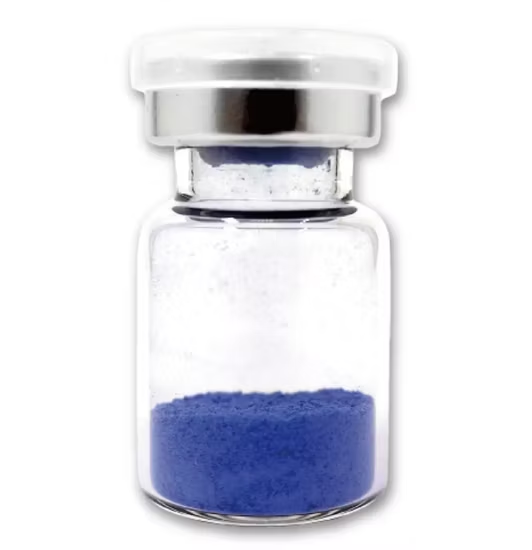 GHK-Cu but driven by IGF-1 and not by direct fibroblast signalling. Body composition changes (modest visceral fat reduction, lean mass preservation or gain) build over 3-6 months and require that you're also training and eating reasonably, this isn't a body-recomposition compound on its own.
If you're not noticing anything after 6-8 weeks at a standard dose, the product is likely under-dosed, degraded, or mislabelled. Grey-market sourcing variance is the most common reason people report nothing.
Side effects & risks:
- Injection site reactions are the most common, mild redness, itching, occasional bruising. Rotate sites
- Headache and lethargy at higher doses or if dosed too late and the GH pulse runs into the morning. Pull the dose back
- Mild water retention and tingling (paraesthesia) in hands and feet at the upper end of the dose range. Early sign of carpal tunnel-type symptoms from elevated GH/IGF-1. Reversible. Reduce dose
- Insulin resistance and elevated fasting glucose. GH is counter-regulatory to insulin and sustained elevation pushes fasting glucose and HbA1c up. Most people see modest changes but meaningful if you already have prediabetes or metabolic syndrome. Recheck at 3 months
- Pituitary desensitisation with continuous long-term use, less of an issue than with longer-acting agents but still the reason most protocols cycle
- Active or recent cancer, avoid. IGF-1 is mitogenic and elevated IGF-1 levels are epidemiologically associated with increased risk of several cancers (colorectal, prostate, breast) over long timescales. Hard contraindication if you have a current or recent cancer diagnosis
- Diabetic retinopathy can worsen with elevated GH/IGF-1. Avoid if you have any active diabetic eye disease
- Sleep apnoea can worsen with GH elevation due to soft tissue changes, monitor if you have it
- Pregnancy and breastfeeding: avoid
- Pituitary tumour or unexplained hyperprolactinaemia: avoid until worked up
- Long-term safety data is essentially absent. The longest controlled human trial was the Beck 2014 Phase 2 in postoperative ileus, which ran 7 days. Beyond 3-6 month cycles, you're inferring safety from related GH literature
- Grey-market sourcing. Most ipamorelin sold online is labelled "research use only" and isn't made under pharmaceutical conditions. Identity, purity, and dose accuracy vary widely. If the product produces strong hunger or cortisol-like effects (anxiety, fluid retention, gynecomastia symptoms) it's likely contaminated with GHRP-6 or GHRP-2. Third-party tested sources are worth the premium
- Regulatory status: ipamorelin sits on the FDA 503A Category 2 list (added 2023, status under PCAC review as of 2026). WADA prohibits it in competition
Blood markers
IGF-1, baseline and at 6-8 weeks. The most useful single marker for whether the compound is working and at what intensity. Aim for the upper end of the age-adjusted reference range, not above it.
Fasting glucose and HbA1c, baseline and at 3 months. The metabolic cost of sustained GH elevation. If fasting glucose creeps above 100 mg/dL or HbA1c above 5.7%, reduce dose or stop.
Fasting insulin and HOMA-IR, baseline if you want a more sensitive read on insulin resistance than glucose alone. Recheck at 3 months.
Full lipid panel, baseline. Recheck at 3 months. GH and IGF-1 can shift lipid markers in either direction.
TSH, free T4, free T3, baseline. GH can suppress TSH and shift T4 to T3 conversion. Worth knowing if you have thyroid history.
Prolactin and cortisol, baseline. Mostly to rule out a pituitary issue before pushing the axis. Ipamorelin itself doesn't meaningfully affect either, which is part of its selling point, but baseline values are useful for context.
For most people the practical minimum is IGF-1 + fasting glucose + HbA1c at baseline and at 3 months. Everything else is for completeness or troubleshooting.
Related compounds without dedicated pages yet:
Tesamorelin
No dedicated page yet, worth adding.
Sermorelin
No dedicated page yet, worth adding.
MK-677 (Ibutamoren)
No dedicated page yet, worth adding.
GHRP-2 and GHRP-6
No dedicated page yet, worth adding.
Hexarelin
No dedicated page yet, worth adding.
HGH (recombinant somatropin)
No dedicated page yet, worth adding.
Sold as a research chemical, not approved for human use in the US, EU, or most jurisdictions.
 Made with Bullet